 |
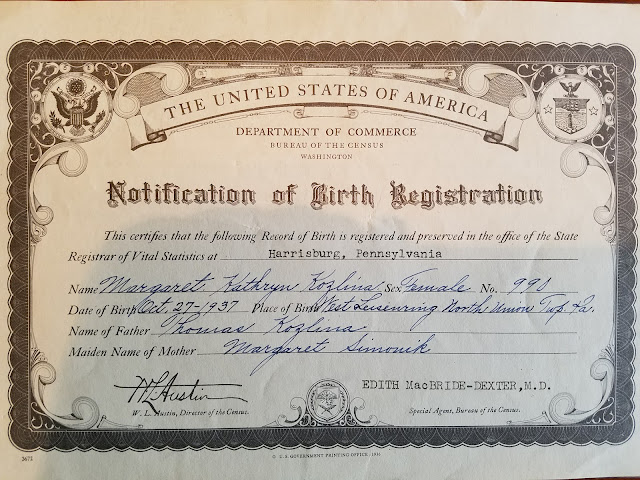
| Mom's first notification of birth registration—with some incorrect information. |
Do you have a document titled Notification of Birth Registration issued by the U.S. Department of Commerce, Bureau of the Census? Was your ancestor born between 1924 and the late 1940s? If so, you may have an interesting document generated by the U.S. Census Bureau to encourage states to create accurate birth records.
I have two documents for my mother, one of which I thought was her actual birth certificate.
- The first one, issued by the Census Bureau, noted her birth date and location, name, and parents’ names. However, her first and middle names were incorrect; she was listed as Margaret Kathryn Kozlina, which was my grandmother’s married name.1
- A second similar document—with her name corrected—was later issued by the Commonwealth of Pennsylvania.2
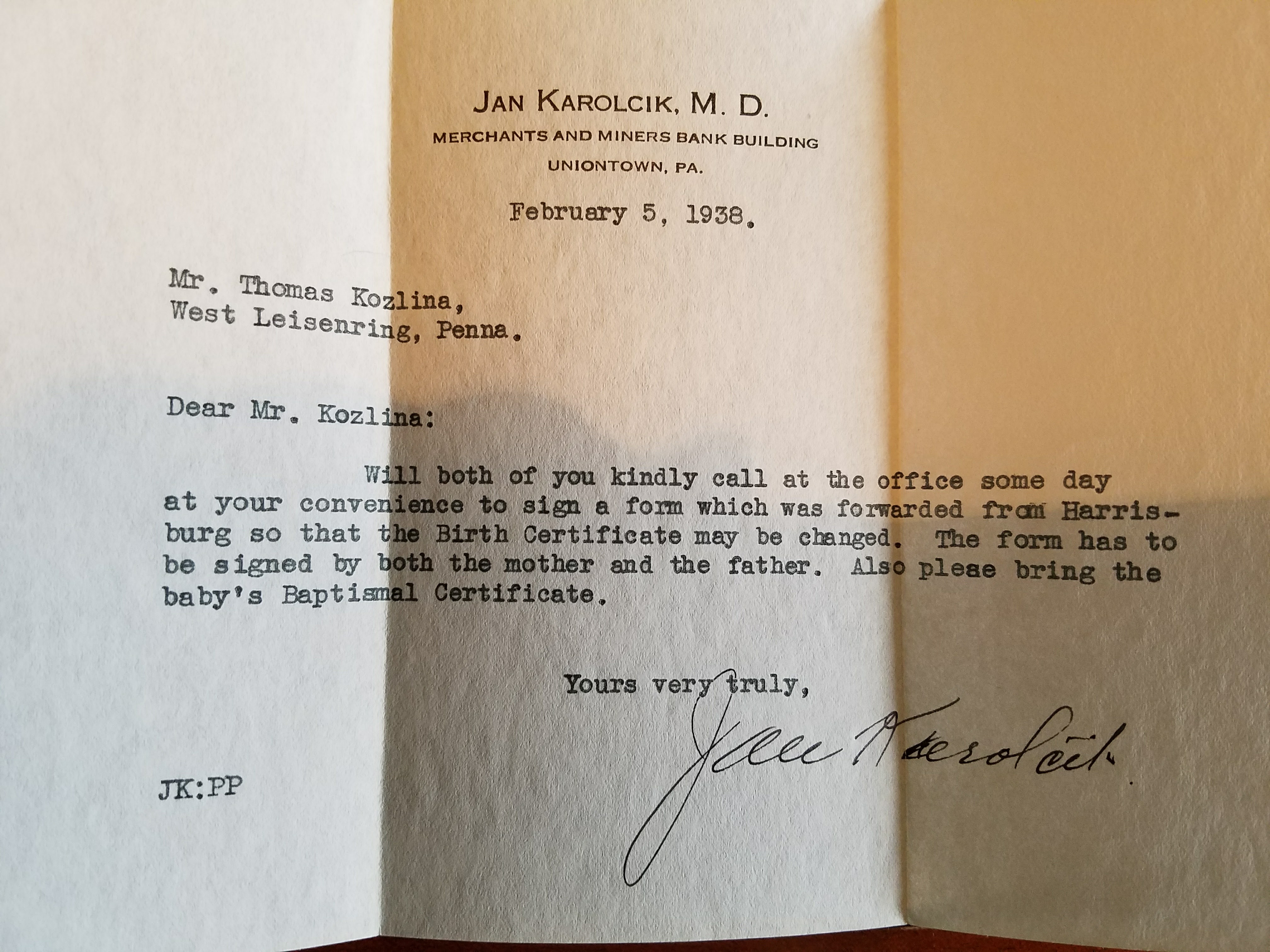
- I also have a letter dated 5 February 1938, from the family doctor, Jan Karolcik, who delivered Mom, asking her parents to come by his office to sign a form to make the needed name corrections.3
 |
| Dr. Karolcik requested my grandparents sign forms to correct Mom's birth registration. |
This scenario is identical to one laid out by the U.S. Census Bureau:
The “Notification of Birth Registration” form, issued by the U.S. Census Bureau during the first half of the twentieth century, is not a birth certificate. The U.S. Census Bureau designed this form in 1924, at the request of various state vital statistics offices, to promote the accurate registration of births in the United States. The notification was completed and sent to parents of newborns when the state office of vital records received information on the birth and made up a birth registration record. If parents found errors in the information shown on the form, they were asked to correct them and return the form so the state’s record could be corrected accordingly. The notification was used until the late 1940s and then discontinued once states were keeping satisfactory birth records.4
 |
| The corrected notification later issued by the Commonwealth of Pennsylvania. |
So, while both documents note my mother’s birth, neither is her actual birth certificate. They simply state that her birth had been registered with the Commonwealth of Pennsylvania. I eventually ordered a copy of her actual state birth certificate from the vital records office in Harrisburg.
If these documents are not vital records, what are they? They are considered family artifacts—more like a hospital-issued birth record with a baby’s footprints on it—than an actual vital record. They do provide clues, however, on what Mom’s birth date and location were, and what her name and her parents names were, which could be confirmed in other documents for genealogical purposes.5
What if I did not have all three documents to view together? What if I only had the first notification? I could have wrongly concluded that Mom’s name was really Margaret Kathryn Kozlina, rather than what it really was.
The takeaway? Looking at all the documents regarding a birth or other event, and resolving the conflicts that they present, provides the best genealogical evidence.
So, if you have ancestors born between 1924–1949, take a second look at what might appear to be a birth certificate—you may have one of these notification documents, too.
Until next time...
Follow my blog with Bloglovin
NOTES
1 Margaret Kathryn Kozlina, b. 27 Oct. 1937, United States Census, notification of birth registration, undated, West Leisenring, North Union Twp., Pennsylvania. Privately held by Nancy Gilbride Casey, Tioga, Texas. Document has the incorrect first and middle names of my mother Anna Margaret Kozlina, b. 27 October 1937; all other info is correct. A later, corrected version was issued by the Commonwealth of Pennsylvania. Document was inherited by author from her mother Anna Margaret Kozlina Gilbride, in 2010.
2 Anna Margaret Kozlina, b. 27 Oct. 1937, Commonwealth of Pennsylvania, notification of birth
registration, undated, North Union Twp., Pennsylvania.
Privately held by Nancy Gilbride Casey, Tioga, Texas. Document has the corrected first and middle names of my mother Anna Margaret Kozlina, b.
27 October 1937; all other info is correct. Document was inherited
by author from her mother, Anna Margaret Kozlina Gilbride, in 2010.
3 Letter from Dr. Jan Karolcik, Uniontown, Pennsylvania, to Mr. Thomas Kozlina, West Leisenring, Pennsylvania, 5 February 1938. Privately held by Nancy Gilbride Casey, Tioga, Texas. Letter requests Mr. Kozlina and wife to sign forms to correct a birth certificate. Letter inherited by author from mother, Anna Margaret Kozlina, in 2010, who inherited it from her mother, Margaret Simonik Kozlina, in 1988.
4 United States Census Bureau (https://www.census.gov/about/policies/foia/age_search_and_birth_records/birth_records.html : 5 November 2023), "Birth Records," last revised 16 December 2021.
5 Evidence Explained (https://www.evidenceexplained.com/content/how-cite-birth-certificate-isnt-really-birth-certificate : 5 November
2023), "How to cite a birth certificate that isn't really a birth
certificate?", posted by Anonymous, 24 April 2015, 10:11 a.m., response
by EE on 25 April 2015, 10:25 a.m.


Comments
Post a Comment