I am participating in 52 Ancestors in 52 Weeks,
a writing challenge encouraging genealogy researchers to write about
their ancestors. The challenge is hosted by genealogist, blogger and
podcaster Amy Johnson Crow.
Here's my post for Amy's Week Twenty prompt: Nature
By Nancy Gilbride Casey
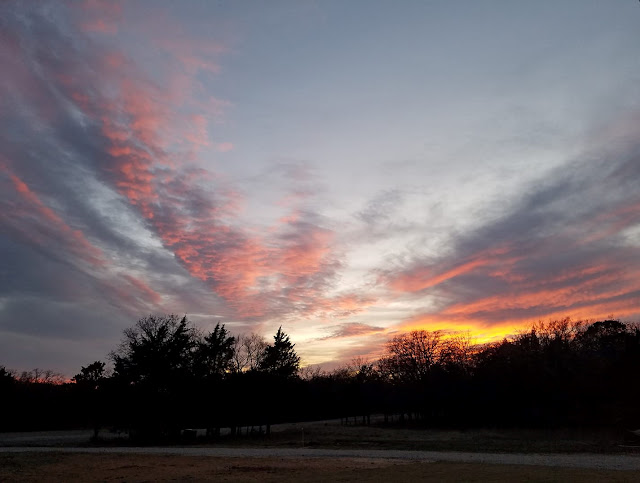 |
| Sunset, winter evening, Tioga—my current home. |
Nature was not something that I noticed early on in life. I was a city-, then a suburb-girl, spending the first seven years of my life either in the Collinwood neighborhood of Cleveland or later, the eastern Lake County suburbs of Eastlake and Willowick. The most I recall of my earliest years is simply a grassy backyard where we had a swing set.
Perhaps it is the myopic child's world-view, but the opening of nature to me came gradually. As I grew, so did my exposure, understanding and appreciation of nature. In small ways, and tiny pockets of memories, I learned about the beauty and strength of nature to be had in the world.
Nature could come quietly, softly, gently. In the hydrangeas which
grew outside my Grandma Kozlina's front steps on Cherokee Avenue. In the
dozens of daffodils which suddenly and unexpectedly appeared alongside the house the first spring we
lived on Blissfield Drive. In the Jack-in-the-Pulpit plants which grew in the woods behind our house, that my brother Tim showed me. In the
incredible rushing sound the wind made as it tossed the high branches of
the oaks in our yard. Or in the stars which peeped out
one by one above me, as I lay on the picnic table enjoying a
summer dusk, while the "lightning bugs" peppered the treeline with their
little yellow bursts.
Nature could also be as vast as Lake Erie, directly to the north, a continual and welcome companion to my life in Ohio. From calm ripples at Headlands Beach to feet-high winter waves breaking on the walls near Burke Lakefront Airport, Lake Erie was my true north.
As a teen, I rode my bike on neighborhood roads north of Lakeshore Boulevard to get a glimpse Lake Erie. I so envied the people who lived in houses that backed right up to the lake. One of my favorite places to go was a city park on Lake Shore Boulevard in Willowick, with swings and benches overlooking a cliff-side view. Sunsets were an achingly beautiful sight to see from there, and I spent many an evening pondering life from the shore.
 |
| Lakefront Park, Willowick, Ohio, one of my favorite places. (Photo by L. Firestone) |
One day, as a garden-variety summer thundershower rolled through, as they often did in the afternoons, I decided to take a walk, without even a coat or an umbrella. I wanted to see how the lake looked when it stormed. About a half-mile away from our house was the remnant of a beach park stairway. The walkway was roped off, and a sign clearly stated NO TRESPASSING. It did not deter me.
I stood a careful number of feet from the edge, and let the wind and rain lash my face and hair, soaking me through. It was an epiphany that I could give myself permission to be immersed in nature. I never felt so alive.
Yet, I also remember the terror I felt
July 4, 1969, when the weather turned wild and stormy and a tornado struck in Willoughby, just south of where we lived then in Eastlake. There was some sort of
method of using a television signal to see if a
tornado was near, which my Dad used that day, and according to the TV, one was near! I was so frightened for my dear Aunt Marian and Uncle Bob who had been visiting and left to go home in the height of that storm.
The weather raged on for what seemed to be hours. Tree limbs fell, lightening fractured the sky and the thunder boomed so loudly. I have a very strong memory of my father going outside to collect downed birds that littered our yard on Dolores Drive, and putting them into the garage so that they would survive the storm. The door was left a crack open at the bottom, so that the birds could fly away when the weather cleared.
I remember being put in our parents' bed to sleep that night, and not sleeping a wink, as the sky continued to crackle and crash through the high bedroom window.
In the morning all was calm and clear and beautiful, though the yard was soggy and flooded, and there were small branches, leaves and twigs everywhere in the yard.
I have learned nature can show two faces. It can dazzle with the saturated yellows, oranges and pinks of a winter sunset over the snow. Or it can terrorize with the crash of a lightning-split tree falling in the yard.
It can amaze with comic bullfrogs, and smiley-face salamanders, like those collected by my brother Joe in the neighborhood woods. Or it could frighten with infestations of bees, wasps, black ants, starlings and squirrels which were forever making our attic and crawlspaces their homes.
We invite nature in, at the same time we try to turn her away. It has always been this way.
Our ancestors tried to pry a living from nature on farms and in coal mines, while others depended on her good graces to move goods down canals and on railways. And they too have been at her mercy through blizzard and wind, scorching summer and droughts.
Some likely marveled—as we do—of the vast beauty of the Poconos and Allegheny Mountains of Pennsylvania, where they first settled to try their fortunes. Others surely welcomed the sun that warmed them during the first thaw after a bitter Ontario winter.
I imagine they, too, welcomed nature as a companion who constantly revealed her secrets and hidden lives, and humbled with every new flower, wildlife visitor, and interesting cloud formation which passed by.
Until next time...


Comments
Post a Comment