 |
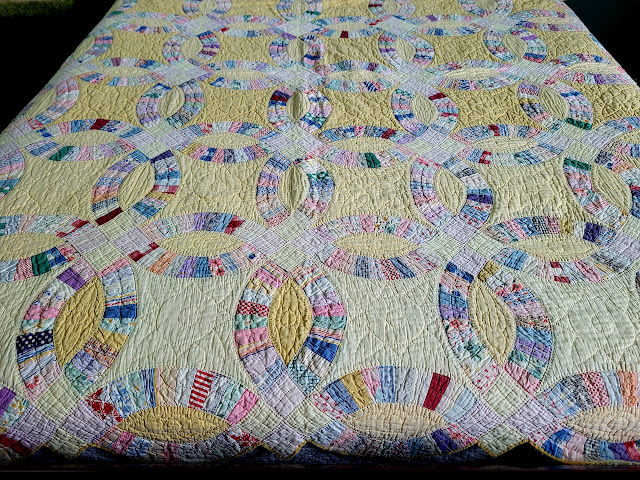
Double Wedding Ring pattern quilt passed down through the Casey family.
|
In this week's post I'm sharing another item created by a female ancestor which has been passed down through the family.
This quilt belonged to Jim's grandparents, Harold Edwin Casey (1915-2009) and Claretta Hall Casey (1917-2000). When Grandma Casey passed away, her son (and my father-in-law) allowed me to pick some items from her home before the house was sold. I've always loved quilts, but never quite had the patience to work on one myself, so this immediately appealed to me.
The design is a traditional Double Wedding Ring pattern. It features interlocking rings symbolizing love and marriage. Mothers or grandmothers often made quilts in this pattern for their children or grandchildren as wedding or anniversary gifts. Folklore suggests that a couple who spent their wedding night under such a quilt would have a blessed marriage. This quilt pattern was very popular during the Great Depression as it could be made with small pieces of fabric from worn out clothing, or from scraps taken from items with sentimental value, such as baby items, or an old shirt or apron.1
 |
Hand quilting details include a flower pattern.
|
This quilt was definitely hand sewn and hand quilted, apparent in the very small, yet slightly uneven stitching. The main color is yellow, and the rings were sewn from a variety of colorful, small-pattern fabrics. I can easily see that these might have been chosen from the "rag bag" of torn or threadbare clothing that was kept for other purposes, such as mending or for creating a beautiful quilt. It was a thrifty use of old fabric that would have been a perfect fit in the Depression era.
 |
The quilt has a single yellow patch on the reverse.
|
Quilters used templates to trace patterns onto the fabric and then stitched over them to create the quilt's texture. In this case, the center of each ring is quilted with a flower pattern, with the oval shapes on the end featuring a pattern reminiscent of an eye! The pattern is more obvious when viewed from the reverse. The back also sports a small patch. Perhaps a hole developed over time, and the maker still had yellow fabric scraps to use for just such a purpose.
The history of this quilt is
unknown beyond being owned by Jim's grandparents. If I had to guess, I would estimate it was created in the
1930s, possibly as a wedding gift for Harold Casey and Claretta Hall
Casey who married in 1937. Perhaps Harold Casey's mother Nellie Frances Taylor Casey (1890-1974) or Claretta's mother Edna Kelso Hall (1883-1975) made it for the couple.2
No matter how or when it was made, I picture this quilt lovingly spread on the couple's bed, gently turned down each night, and smoothed over each morning after the bed was made. Or pinned to a clothesline in the summer sunshine, swaying in the breeze.
A blessing indeed.
Until next time...
Follow my blog with Bloglovin
NOTES
1 AccuQuilt (https://www.accuquilt.com/blog/a-history-of-the-double-wedding-ring-quilt), 15 April 2017, "A History of the Double Wedding Ring Quilt."
2 "Oklahoma, U.S., County Marriage Records, 1890-1995," Ancestry (https://www.ancestry.com/imageviewer/collections/61379/images/TH-1-159393-909774-78 : 8 August 2023), marriage of Harold Edwin Casey and Claretta Hall, 26 June 1937; citing County Courthouse, Kingfisher.


Comments
Post a Comment